

Friends, I want to walk with you through something that has stirred many of us. It starts in a simple verse in Acts and leads us right into the question of how the Holy Spirit still works today. You can look these verses up for yourself in your Bible or on the Blue Letter Bible ~ which is a wonderful tool.
Acts 21:4 (NKJV)
“And finding disciples, we stayed there seven days. They told Paul through the Spirit not to go up to Jerusalem.”
Paul is on his way to Jerusalem. Everywhere he goes the Holy Spirit is warning him of chains and tribulations (Acts 20:22-23). At Tyre the disciples receive a word through the Spirit and tell him not to go. Later, at Caesarea, Agabus the prophet takes Paul’s belt, binds himself, and says, “Thus says the Holy Spirit, ‘So shall the Jews at Jerusalem bind the man who owns this belt, and deliver him into the hands of the Gentiles’” (Acts 21:11).
The Spirit was speaking here and the disciples at Tyre loved Paul. They heard the warning of suffering and turned it into a command: “Don’t go.” Paul understood the same Spirit differently. He was ready not only to be bound but also to die for the name of the Lord Jesus (Acts 21:13). When they could not persuade him, they said, “The will of the Lord be done.”
The Lord had already told Ananias at Paul’s conversion, “I will show him how many things he must suffer for My name’s sake” (Acts 9:16). God was faithful. He kept showing Paul the cost. The Spirit warned of the price. The disciples added their own conclusion.
Can the Spirit still speak through other believers today?
Yes. The same Holy Spirit who spoke then still speaks now. He still uses words of warning, words of knowledge, and prophecy to prepare, encourage, and guide His people. The gifts did not stop when the last page of the New Testament was written. God did not give the church the Spirit and then take the gifts away.
But folks we must be careful and prophecy must be tested (1 Corinthians 14:29; 1 Thessalonians 5:21). The Spirit never contradicts the written Word. Love can colour what we hear. A true word from the Spirit about difficulty can be turned by our hearts into “God is telling you to stop.” Paul kept going because he was bound in the Spirit to go. The warning did not cancel the call. It prepared him for the cost.
Some Reformed views
Many of our Reformed brothers hold that the miraculous ways God once used to speak directly ceased when the New Testament was completed. They teach that the gifts of prophecy, tongues, and the word of knowledge belonged to the time when the Scriptures were still being given. Once the canon was finished, those temporary means ended.
They say God still speaks today, but He speaks through the finished written Word. The Holy Spirit illuminates what has already been written. He does not add new revelation beside it.
We honour their deep love for the sufficiency of Scripture. That is a good and necessary love. We share it. The written Word remains our final authority. Nothing the Spirit says today will ever contradict what He has already given us in the Bible. But we do not find in the New Testament itself the clear statement that these gifts stopped when the last book was written.
But we do not find in the New Testament the statement that these gifts ceased when the last apostle died or the last book was finished. You can study these passages carefully on the Blue Letter Bible and see for yourself.
1 Corinthians 13 and “that which is perfect”
This brings us to the passage many use to say the gifts have ended.
1 Corinthians 13:8-12 (NKJV)
“Love never fails. But whether there are prophecies, they will fail; whether there are tongues, they will cease; whether there is knowledge, it will vanish away. For we know in part and we prophesy in part. But when that which is perfect has come, then that which is in part will be done away. When I was a child, I spoke as a child, I understood as a child, I thought as a child; but when I became a man, I put away childish things. For now we see in a mirror, dimly, but then face to face. Now I know in part, but then I shall know just as I also am known.”
Some say “that which is perfect” is the completed New Testament. Once the canon was closed, the partial gifts ended. But the language of the passage itself points elsewhere.
Paul says we see now “in a mirror, dimly,” but then “face to face.” He says we know now “in part,” but then we shall know fully, even as we are fully known. A finished book does not look at us. A finished book does not know us. This is personal. This is the day we meet the Lord Himself.
How the Greek works it out
The key phrase is di’ esoptrou en ainigmati — “by means of a mirror, in a riddle.” You can check the Greek on the Blue Letter Bible.
Esoptron (mirror) was not clear glass. In Paul’s day mirrors were polished metal, usually bronze. Corinth was famous for them. You could see a reflection, but it was never perfectly sharp.
En ainigmati means “in an enigma” or “in a riddle.” Our English word “enigma” comes from this. The picture is obscure, incomplete, not fully clear.
So Paul is saying: right now we see by means of a metal mirror, and the image is like a riddle. It is real, but dim. Then he contrasts it: “but then face to face.”
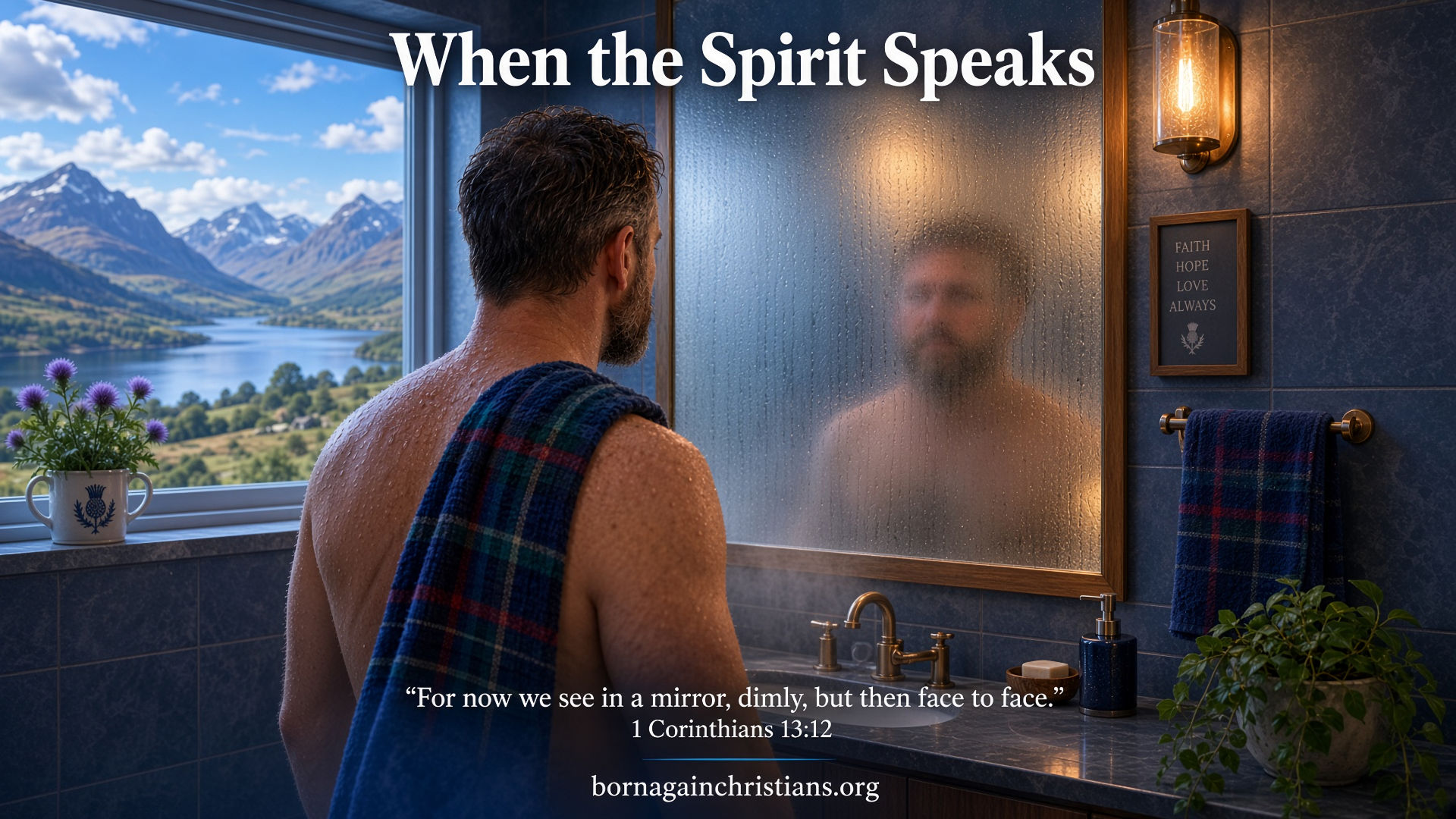
This modern illustration can help us. Think of a bathroom mirror right after you have a hot shower. The glass is covered with steam but you can still see your face. You know it is you. But your details are blurred. You wipe a small clear spot and see a little better, yet the your whole image stays foggy until the steam is gone. That is our present knowledge. Enough light to walk by faith. Not the full, clear sight that is coming.
When the Lord comes for His church — at the rapture — the steam will be gone. We will see Him face to face. No more metal mirror. No more riddle. Full knowledge. That is “that which is perfect.”
T. Kendall, who pastored Westminster Chapel for many years, has written strongly against the idea that the gifts ceased with the canon. He says cessationism has no solid biblical foundation. It became a convenient explanation when the gifts were not being seen. He reads 1 Corinthians 13 the same way: the partial remains until we see face to face.
Holding both the Word and the Spirit
Importantly we do not set the Spirit against the Word, it is the same Spirit who inspired the Scriptures still works among His people. He still warns, still guides, still distributes gifts as He wills (1 Corinthians 12:11). We test everything by the written Word. We refuse to put experience above Scripture. And we keep looking for the day when the mirror is gone and we see Jesus face to face.
You have not been robbed, brother. The gifts did not end when the last page of Revelation was written. The mirror is still dim. Face to face is still ahead. Until that day, keep your Bible open and your heart open. The Spirit is faithful. The Lord is coming.
Praise His name.
For further study, open these passages, use a good reference Bible or use your Bible with Blue Letter Bible and use the tools there. Let the Word speak for itself.









Add comment