

Folks, good morning from a dry, overcast Scotland and let’s sit down together and look at the man called Judas Iscariot, and at the ordinary meal that became the most solemn table in history.
Jesus had chosen him. That is the starting point. In John 6:70 He said to the twelve, “Did I not choose you, the twelve, and one of you is a devil?” John immediately tells us He was speaking of Judas Iscariot, the son of Simon, who would betray Him. Earlier in the same chapter we read that Jesus “knew from the beginning who they were who did not believe, and who would betray Him” (John 6:64, NKJV).
He was not surprised and wasn’t not caught off guard. Yet He still walked with Judas for three years. He still entrusted him with the money box. He still washed his feet that night. The Scriptures had already spoken of a close friend who would lift up his heel against the Messiah (Psalm 41:9). God is never surprised. At the same time, Judas made his own choices. The Lord knew the heart, and the heart still chose.
John tells us plainly what was already in that heart. In John 12:6 we read that Judas “was a thief, and had the money box; and he used to take what was put in it.” He complained when Mary poured the costly perfume on Jesus’ feet, saying it should have been sold for the poor. But John says he did not care about the poor. He cared about the money he could take for himself. Greed was already at work. It grew until he was willing to sell the Lord for thirty pieces of silver.
The other disciples never saw it. When Jesus said one of them would betray Him, they all looked around and asked, “Is it I?” None of them pointed at Judas. He had learned how to look the part. He had gone out with the others, preached, and seen miracles. He carried the bag. He sat close enough that night to receive the piece of bread from the Lord’s own hand. But he never fooled Jesus.
Now let’s look at the meal itself, because the ordinary food on that table helps us see the man more clearly.
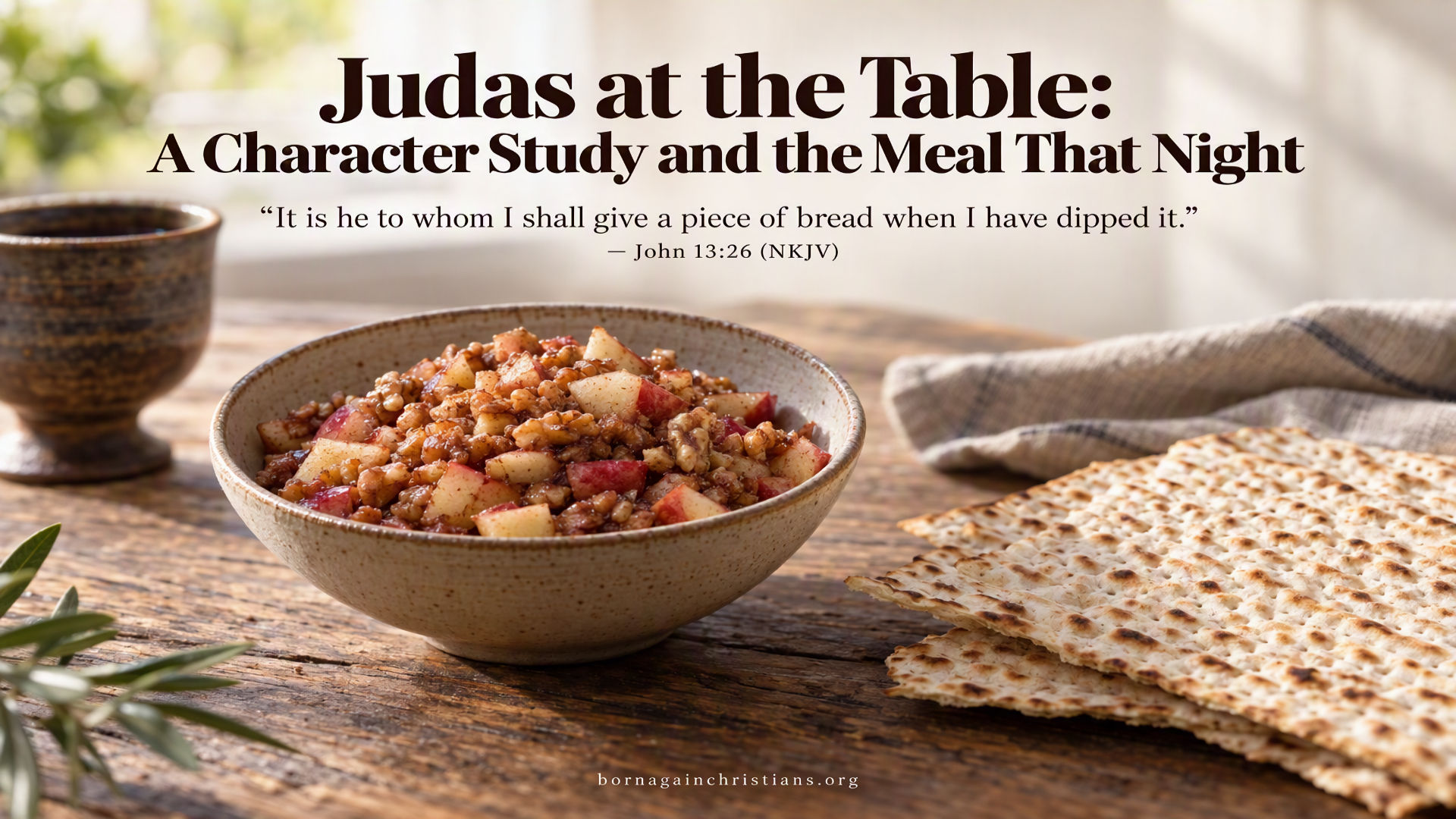
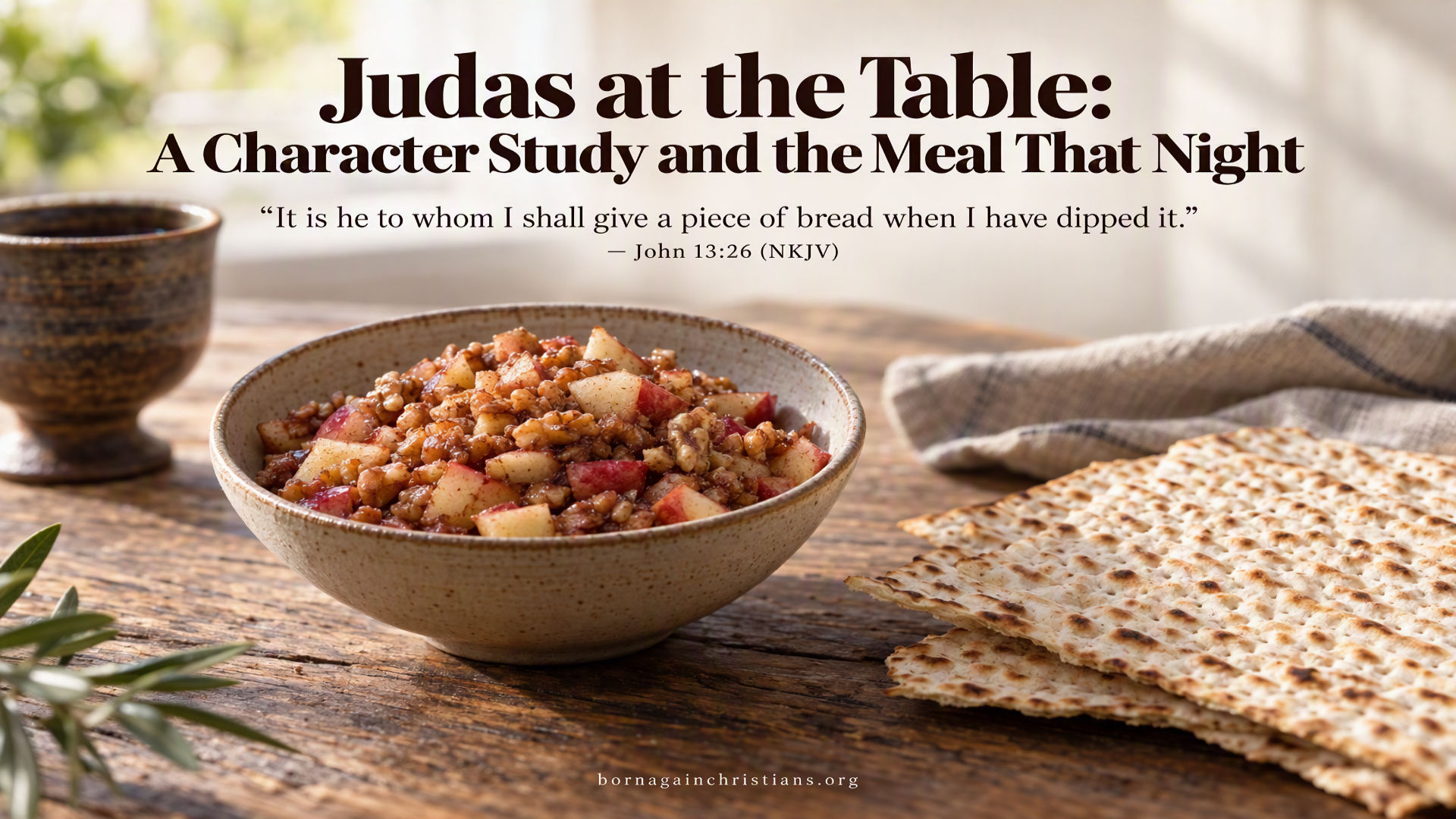
They were gathered for a Passover meal. The Gospels place this supper in the context of the feast that remembered Israel’s deliverance from Egypt. They reclined at a low table, as people did in those days, not sitting upright on chairs the way we picture it in later paintings. There was unleavened bread—matzah—flat and crisp because there was no time for the dough to rise when they left Egypt. There were bitter herbs, called maror, to remember the bitterness of slavery. And there was a thick, sweet paste called charoset, made of chopped fruit (apples or dates), nuts, spices, and a little wine or grape juice. It looked something like the mortar the slaves had used for bricks. That is the name for the dish we have been talking about: charoset.
Think of the little shared plates you get at the start of a meal in a restaurant—olives, tomatoes, cheese or something similar sitting in oil. Everyone reaches into the same bowl. That is close to what was happening. The host would take a piece of the bread, dip it into the shared dish of charoset (or the dish that held the herbs and the paste), and hand it to someone as a mark of special friendship or honour. It was an ordinary, warm gesture at a Jewish table.
That is what Jesus did. In John 13:26 we read that He answered, “It is he to whom I shall give a piece of bread when I have dipped it.” And having dipped the bread, He gave it to Judas. It was a gesture of friendship, even then. Some of the others thought He was simply sending Judas out to buy something for the feast or to give something to the poor, because Judas carried the money box. They did not fully grasp it in the moment. Only later, as the Holy Spirit guided John to write it down, do we see it clearly.
After Judas took the piece of bread, the Scripture says Satan entered into him. Jesus said, “What you do, do quickly.” And Judas went out into the night.
Here is the depth of it. The same Lord who knew the thief’s heart still offered that last token of kindness. The same hand that would be pierced still handed him the dipped bread. Judas had every opportunity. He had heard the teaching. He had seen the power. He had sat at the table. Yet greed and unbelief won. Jesus later said of him, “It would have been good for that man if he had not been born” (Matthew 26:24). It is a sobering word. The only one of whom the Lord spoke that way.
We do not need to solve every mystery of how divine foreknowledge and human choice sit together. The Scripture simply shows us both. God knew. Judas chose. And the plan of redemption went forward exactly as the Scriptures had said.
The application is close to home. The Lord still knows every heart that sits at His table. He sees the motives we hide from others and sometimes from ourselves. He is never fooled. At the same time, He still draws near with grace. He still offers friendship. The question is what we do with that offer.
May the Lord search our own hearts and keep us close to Himself. Blessings to you.























Add comment