

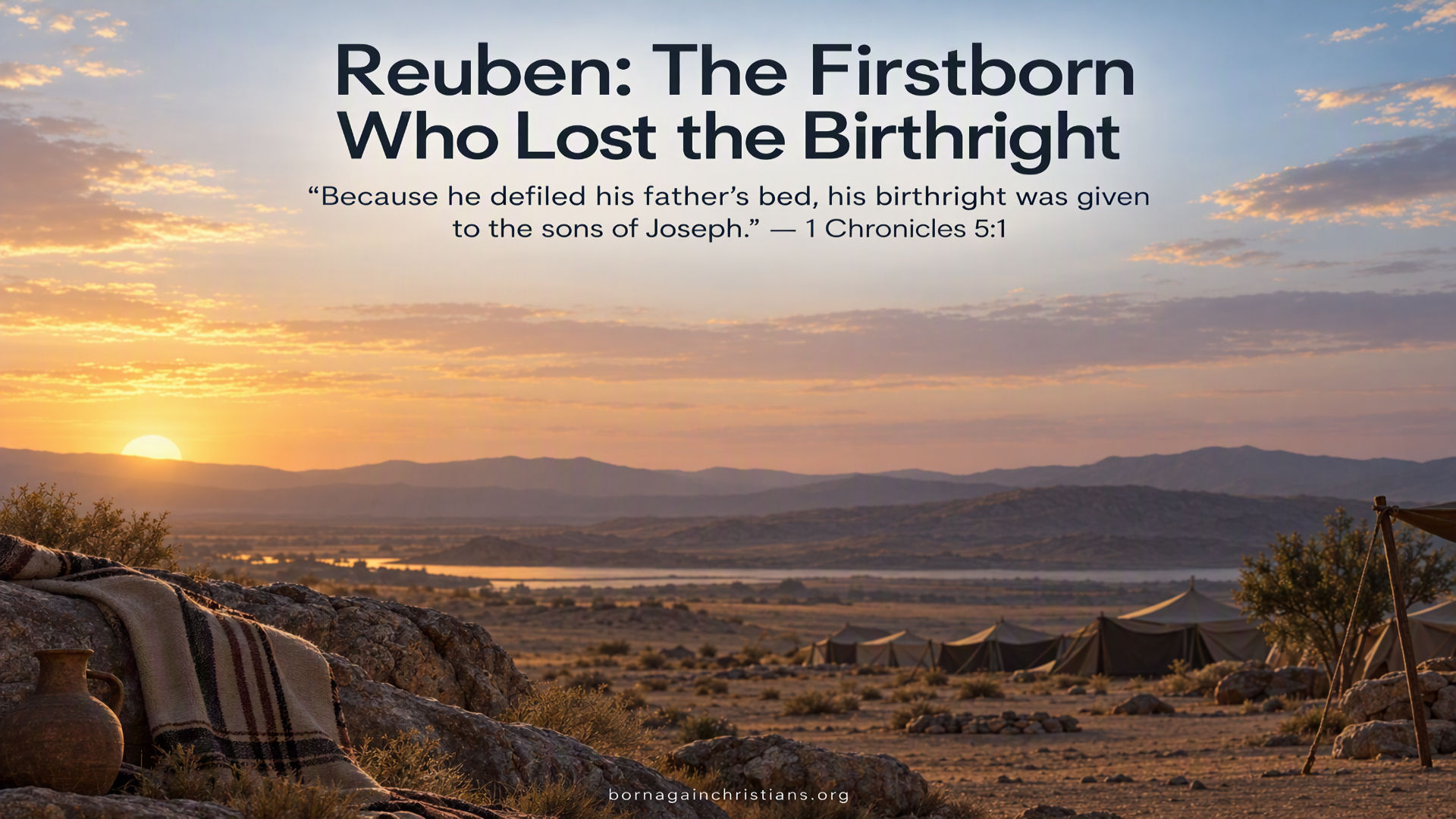
A Character Study from 1 Chronicles 5 and Genesis
Well, as we come to 1 Chronicles 5, the genealogies of Israel turn to the tribes that settled east of the Jordan River: Reuben, Gad, and the half-tribe of Manasseh. Before the lists of names begin, the chapter pauses to explain why Reuben, though he was the firstborn, did not keep the rights that normally belonged to him.
“Now the sons of Reuben the firstborn of Israel—he was indeed the firstborn, but because he defiled his father’s bed, his birthright was given to the sons of Joseph, the son of Israel, so that the genealogy is not listed according to the birthright.” (1 Chronicles 5:1, NKJV)
What Reuben Did
The story is told simply in Genesis 35:22. After Rachel died, while Jacob (Israel) was living near Bethlehem, Reuben went and lay with Bilhah, his father’s concubine. Bilhah had been Rachel’s handmaid. Rachel had given her to Jacob when she herself could not have children, and Bilhah bore Dan and Naphtali—two of the twelve tribes.
Jacob heard what happened. Years later, on his deathbed, he spoke of it directly:
“Unstable as water, you shall not excel, because you went up to your father’s bed; then you defiled it—he went up to my couch.” (Genesis 49:4, NKJV)
In that day, taking a father’s concubine was more than immorality. It was also an act of rebellion—an attempt to claim the father’s place and authority in the household. The Law later made the same act clearly forbidden (Leviticus 18:8; 20:11). Jacob never forgot it, and the birthright (the double portion and the leadership that belonged to the firstborn) was taken from Reuben and given to the sons of Joseph. The promise of the ruler went to Judah.
A Brief Look at Bilhah
We know Bilhah was a servant, she wasn’t a full wife like Leah or Rachel. Yet God used her. Through her came the tribes of Dan and Naphtali. Scripture does not tell us about her future or any personal consequences she faced. The focus remains on Reuben’s act. She continued with the family and is listed among those who went down to Egypt (Genesis 46:25). Her sons were counted among the twelve.
What This Means for Us
Reuben’s story still speaks to us today.
You know, sin has consequences, even when it’s not exposed at the time. The act happened years before Jacob named it, yet the birthright was still lost. Folks we can’t assume a past private failure is finished simply because no one has confronted us right away.
God takes the marriage bed seriously and what Reuben did was both sexual sin and rebellion against his father’s place. Scripture still calls the marriage bed honourable and tells us to keep it pure (Hebrews 13:4). Guarding our hearts, our eyes, and our relationships remains part of walking with the Lord.
God is sovereign even when people fail. The birthright went to Joseph’s line and the ruler came through Judah—the line of the Messiah. Our failures do not stop His plan. He continues to work His purposes and still numbers those who belong to Him.
As you study this passage, you will see that the rest of 1 Chronicles 5 shows what happened to those same tribes later. They cried out to God and won a battle, but in time they acted unfaithfully and were carried into captivity by Assyria. Faithfulness matters. The call is simple: walk in the light, keep a clean heart, and stay close to the Lord who is merciful when we repent.
Reuben began with every advantage of the firstborn. One act of instability and rebellion cost him the place that was his by birth.
May we learn from his loss, and may the Lord keep us pure and submitted as we walk with Him.
























Add comment