

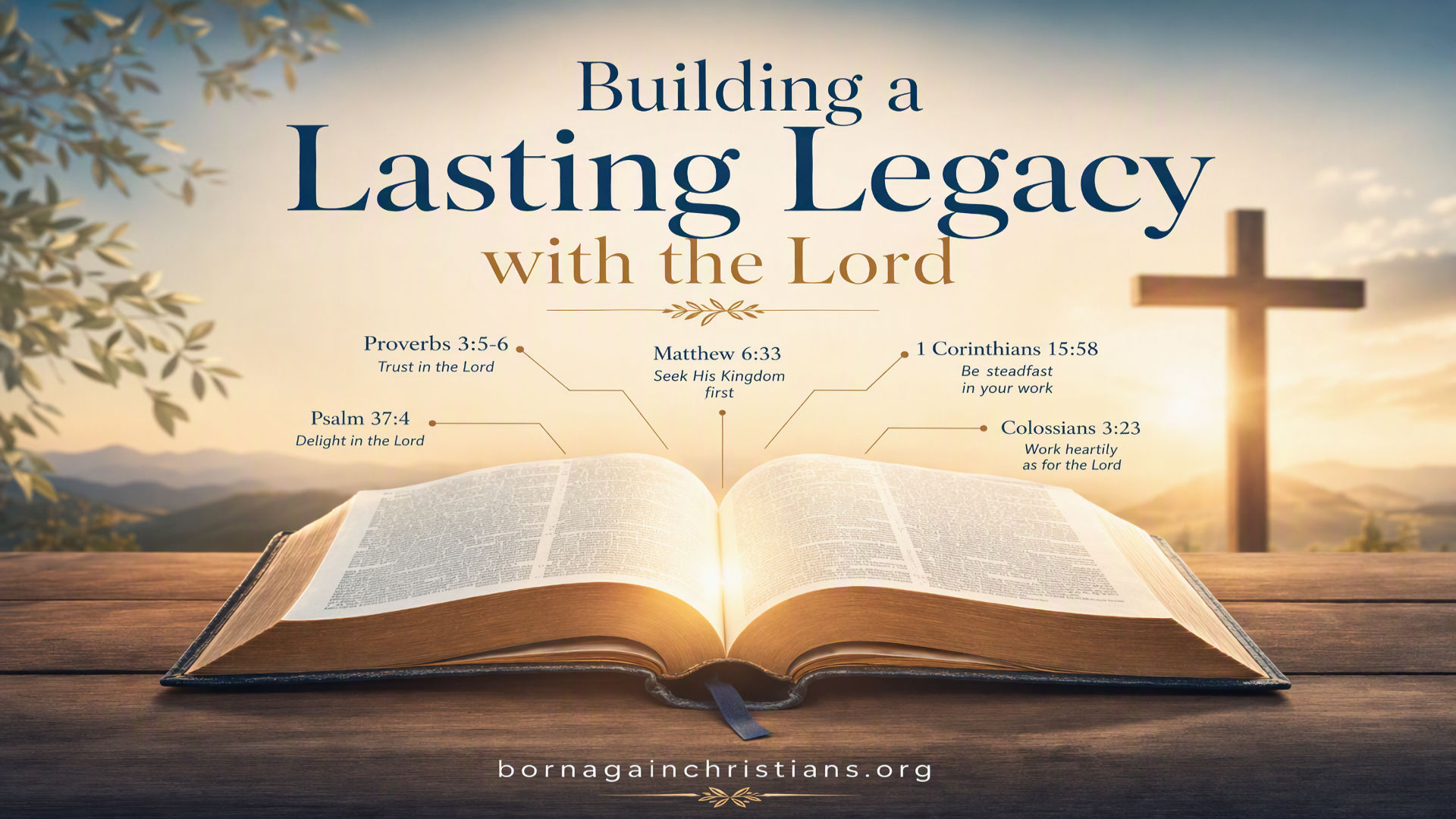
When we think about leaving a legacy, most people picture something the world can measure—money in the bank, a name people remember, buildings with plaques on the wall, or influence in politics and public life. Yet the Word of God measures legacy differently. Jesus said, “Do not lay up for yourselves treasures on earth, where moth and rust destroy and where thieves break in and steal; but lay up for yourselves treasures in heaven… For where your treasure is, there your heart will be also” (Matthew 6:19-21 NKJV). A true legacy is not what we accumulate for ourselves, but what the Lord works in us and through us as we walk with Him.
Recently many of us have been reminded of this as we thought about Charlie Kirk. His birthday has just passed, and he has a wife and two children. What stands out is not a carefully calculated plan to become famous in politics, but a life that has been shaped by faith in Jesus Christ. He has spent time around men who simply want to teach the Bible as it is written—biblicists rather than those locked into a Calvinist or Arminian system. That kind of influence does not come from seeking a platform. It comes from letting the Word of God form the heart and the choices day by day. When a man’s life is ordered by trust in the Lord rather than by the desire for earthly recognition, the fruit that remains is of a different kind. Even after he is gone, that life still speaks (Hebrews 11:4).
This stands in sharp contrast to the approach of many prosperity preachers. They constantly ask for money so they can “leave something behind.” Yet the love of money is a root of all kinds of evil (1 Timothy 6:10). When the message drifts from knowing Christ to building a personal empire, it has already left the gospel. The Lord spoke plainly to the lukewarm church in Laodicea: “So then, because you are lukewarm, and neither cold nor hot, I will vomit you out of My mouth” (Revelation 3:16 NKJV). God is not impressed by religious activity that is really about securing an earthly inheritance. He looks for a heart that loves Him and a life yielded to His Word.
How, then, do we build a legacy that lasts? We do it the way faithful men have always done it—by taking time in the Word of God and letting the Bible interpret itself. Dr. Ian Paisley used to say that the best commentary on the Bible is the Bible itself, and he encouraged people to use a good reference Bible, such as a Cambridge, with its cross-references and comprehensive concordance. Chuck Smith taught the same simple principle for decades at Calvary Chapel. When a verse is hard to understand, we do not immediately run to a man’s system or commentary to force a meaning. We stay in the text. We look at the immediate context. We follow the cross-references. We check how the same word or truth appears elsewhere in Scripture. We let clearer passages shed light on harder ones. The Holy Spirit, who inspired the whole Book, is the best Teacher.
A good reference Bible and a thorough concordance make this practical. The cross-references send you from one passage to another so that Scripture explains Scripture. The concordance lets you see every place a word is used, so the Bible defines its own terms. Today the same work can be done with online tools such as the Blue Letter Bible along with your Bible. Click on a word, see every occurrence, read the surrounding verses, and let the Word speak. You start with the text and you stay with the text.
This daily practice is how a lasting legacy is built —> It is not intense —> It is the quiet —> and consistent opening of the Scriptures, comparing verse with verse, and allowing the Lord to shape your thinking, your family, and your witness. Paul could say at the end of his course, “I have fought the good fight, I have finished the race, I have kept the faith” (2 Timothy 4:7 NKJV). He did not leave a fortune. He left the gospel and lives that had been pointed to Christ. That is the inheritance that remains.
So keep taking time in the Word —> Let it interpret itself —> Let it form your days. The world will keep measuring success by what can be counted and displayed. The Lord measures by a heart that treasures Him and a life that bears eternal fruit. That is the legacy worth building—one that neither moth nor rust can touch, and that will still be speaking long after we are gone. The Lord is faithful. He will complete the work He has begun.
A Wee Bible Study: What Does the Word “Elect” Really Mean?
This is not just theory. The same simple method of letting the Bible interpret the Bible can be used with any word or passage that people debate. Take the word “elect,” for example. Instead of accepting what a system tells us it must mean, we can open the Scriptures and see for ourselves.
One of the best ways to grow is to take a word that people argue about and simply open the Bible and let it speak for itself. Many Calvinists teach that “elect” means God chose certain individuals for salvation before the foundation of the world, and everyone else was passed over. But is that what the Bible itself shows when we look carefully at how the word is used? Let’s do what we talked about earlier—open the Word, use a concordance or the cross-references in a reference Bible (or the Blue Letter Bible), and see what Scripture actually says.
Start in Matthew 24. Jesus is speaking about the great tribulation that is coming. He says, “And unless those days were shortened, no flesh would be saved; but for the elect’s sake those days will be shortened” (Matthew 24:22 NKJV). A few verses later He warns that false christs and false prophets will arise “to deceive, if possible, even the elect” (Matthew 24:24). Then He speaks of the Son of Man coming and sending His angels to “gather together His elect from the four winds” (Matthew 24:31).
Now ask yourself a simple question as you read the chapter: Who is Jesus talking about here? Is He describing people who were individually chosen for salvation long before they were born, or is He speaking about a group of believers who will be alive during that terrible time of tribulation? Look at the context. The whole chapter is about the end of the age, the abomination of desolation, and the distress that comes upon the earth. Many Bible teachers who simply follow the text see these “elect” as Jewish believers (and perhaps Gentile believers with them) who come to faith during the tribulation and are protected and gathered by the Lord.
Don’t stop there. Take your concordance or go to the Blue Letter Bible and look up every place the word elect (or election, chosen) appears. You will find it used in different ways:
Sometimes it refers to the nation of Israel as God’s chosen people (Isaiah 45:4; Romans 11:28).
Sometimes it describes the church—the body of believers—as God’s elect (Colossians 3:12; 1 Peter 1:1-2; 2 Timothy 2:10).
And, as we just saw, sometimes it points to believers who will be on the earth during the tribulation (Matthew 24).
Notice that in none of these places does the Bible require us to conclude that God unconditionally selected some individuals for heaven and rejected the rest to go to hell. When Peter writes to “the elect according to the foreknowledge of God” (1 Peter 1:2), he is writing to real people who have already believed. The focus is on God’s knowing and setting apart those who are His, not on a secret decree that bypasses human response to the gospel.
This is why we stay with the text and let the Bible interpret the Bible. A theological system may want every use of “elect” to mean the same thing—unconditional individual election unto salvation. But when you actually open the Scriptures and read each passage in its own context, you see the word used for Israel, for the church as a body, and for tribulation saints. The meaning is shaped by the passage, not by a system we bring to the passage.
Here is a simple way to study it yourself this week:
1… Read Matthew 24:15-31 slowly. Who are “the elect” in that setting?
2… Look up Colossians 3:12 and 1 Peter 1:1-2. Who is being addressed?
3… Check Romans 11:5-7 and 11:28. How is election spoken of in relation to Israel?
4… Use your concordance or Blue Letter Bible to see if there are other important uses you should consider.
You don’t need a thick systematic theology book to do this. You need an open Bible, a willingness to read the context, and the cross-references or concordance that send you to related verses. That is exactly the method Dr. Paisley encouraged with a good Cambridge reference Bible, and the same approach Chuck taught for years—let the Scriptures speak, and don’t force them into a mold.
When we take time to search the Word this way, something wonderful happens. We stop arguing about labels and viewpoints and start seeing what God actually said. With this kind of careful, humble study is part of the legacy we build with the Lord—one verse, one word, one open Bible at a time. The Holy Spirit is ready to teach anyone who will simply look. So keep studying, keep searching, and let the Word shape the life you leave behind.














Add comment